

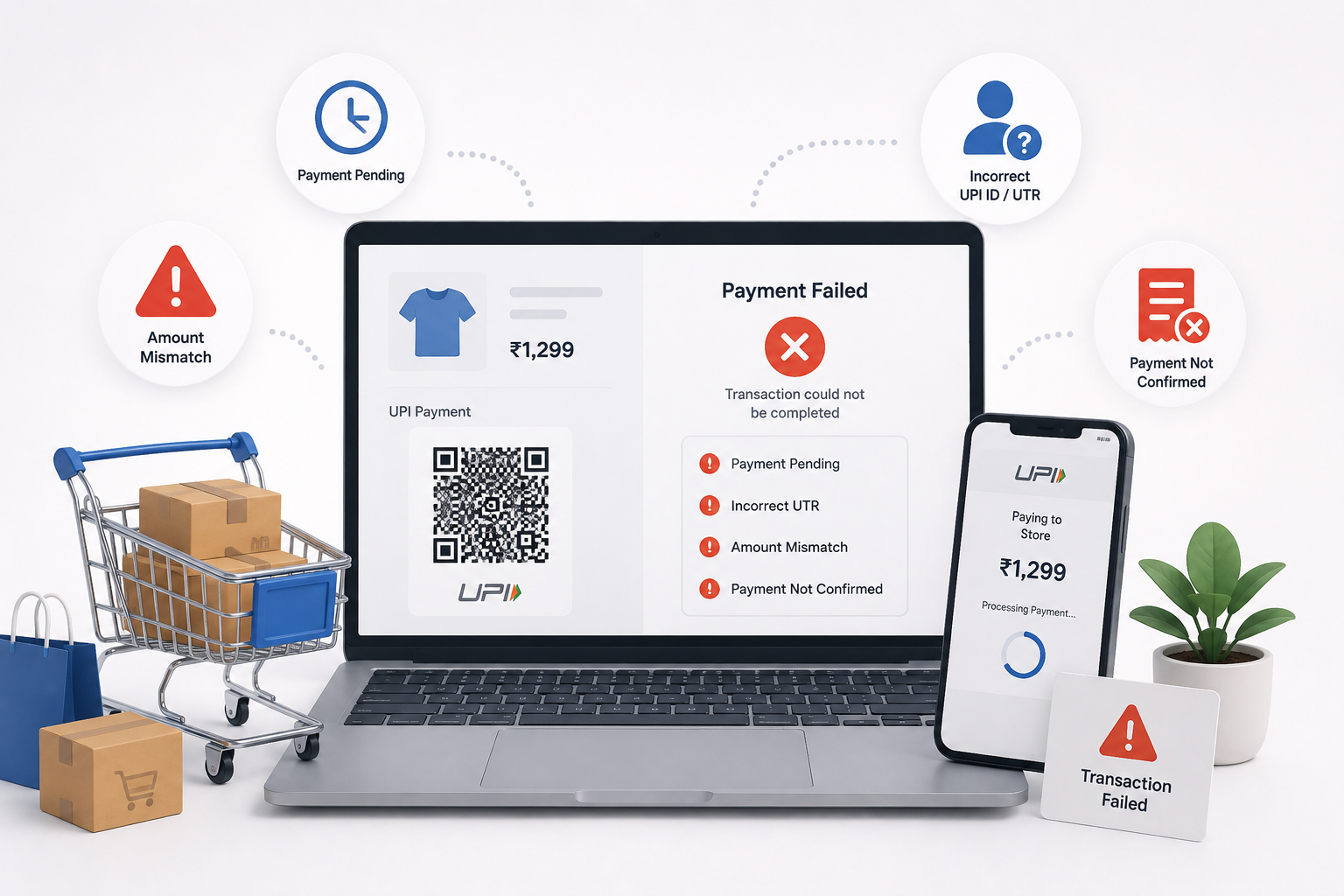
UPI is how India loves to pay. For shoppers, it is effortless. But for online store owners and D2C brands, managing UPI payments behind the scenes can turn into a daily operational headache.
When payments fail, take too long to confirm, or eat into your margins, it directly impacts your sales, customer reviews, and daily workload.
Here are the 6 most common UPI payment problems Indian e-commerce merchants deal with and the practical ways to eliminate them.
1. The "Money Deducted, Order Failed" Customer Panic
Every store owner knows this urgent WhatsApp message:
"₹1,850 was debited from my Google Pay, but your site says payment failed and no order was placed! Please refund or send my order!"
- The Problem: During peak hours, a small network delay can cause your website checkout to time out before receiving confirmation from the bank.
- The Cost to You: An anxious customer, an urgent support ticket, and the risk of losing a repeat buyer.
- The Fix: Instead of immediately cancelling the order when there is a short delay, modern stores hold the order in a temporary "Verifying Payment" status while checking the confirmation in the background. Once confirmed, the order flips to "Paid" without causing customer panic.
2. The WhatsApp Screenshot & Manual UTR Verification Trap
Many stores try to avoid transaction fees by showing a static QR code, asking customers to share a screenshot on WhatsApp or type in their 12-digit UTR number.
- The Problem: It works for 5 orders a day. At 50 orders a day, your team spends hours opening bank portals, searching 12-digit numbers, and updating order statuses by hand.
- The Cost to You: Fulfillment is delayed by hours. Worse, fake payment receipt generators make it easy for scammers to send fabricated screenshots that look completely genuine.
- The Fix: Use an automated, one-click UPI checkout. The exact order total is locked, the customer taps to pay, and your store confirms the order the second the money lands—no screenshots, no typing numbers, and zero manual checking.
Learn More about Manual UTR
3. Mobile Checkout Drop-Offs (In-App Browser Blocks)
Most online shoppers discover products through ads on Instagram, Facebook, or WhatsApp.
- The Problem: When a customer clicks your ad inside Instagram and taps "Pay via UPI," the built-in Instagram browser often blocks the button from smoothly opening Google Pay, PhonePe, or Paytm. The screen goes blank or freezes, and the buyer simply exits.
- The Cost to You: Wasted ad spend and high cart abandonment right at the final step.
- The Fix: Use a checkout setup that detects in-app browsers and either smoothly passes the payment intent to the customer's installed UPI app or displays a quick on-screen QR code so checkout never stalls.
4. Accidental Double Payments from Impatient Customers
When a checkout screen buffers or shows a loading spinner for more than a few seconds, a customer's first reaction is to hit "Back" and click "Pay" again.
- The Problem: If the first payment was already processing, the customer gets charged twice from their bank account.
- The Cost to You: You get two orders for the same item or an overpaid order. Your team now has to process a manual refund, manage the accounting mismatch, and explain the delay to the customer.
- The Fix: Automatically disable and lock the payment button the moment the customer clicks it, displaying clear progress text: "Please do not refresh or press back while we confirm your payment."
5. The 2% Gateway Fee Eating Your Margins
Most standard payment gateways charge a 2% cut on every single transaction.
- The Math: If your store does ₹10 Lakhs in monthly sales, you hand over ₹20,000 every single month (₹2.4 Lakhs a year) purely in transaction fees.
- The Cost to You: On thin-margin products like apparel, electronics, or packaged foods, a 2% top-line fee can wipe out 10% to 20% of your actual net profit.
- The Fix: Since UPI is natively a direct bank-to-bank transfer, scaling stores are moving toward direct UPI payment infrastructure that operates on transparent flat pricing rather than taking a percentage cut of every order.
6. Delayed Payouts and Stuck Cash Flow (T+2 Settlements)
When an order is paid on Friday afternoon through traditional payment aggregators, the funds rarely reach your current account until Monday or Tuesday evening.
The Fix: Switch to payment infrastructure where customer UPI payments settle directly into your own bank current account in real time, giving you immediate access to your cash.banking pipe experiences high latency, transactions are seamlessly routed through an alternative rail.
The Problem: Your revenue sits in an intermediary account over weekends and bank holidays.
The Cost to You: You cannot restock inventory promptly, supplier payments stall, and your daily working capital feels constrained even when sales numbers look great.
You started your online brand to build great products and scale your business not to spend your days chasing UTR numbers, calming down panicked buyers, or giving away hard-earned profits to 2% transaction fees.
Upgrading your store's payment checkout to handle instant confirmation, direct bank settlements, and automated order updates takes the friction out of payments so you can focus 100% on growth.